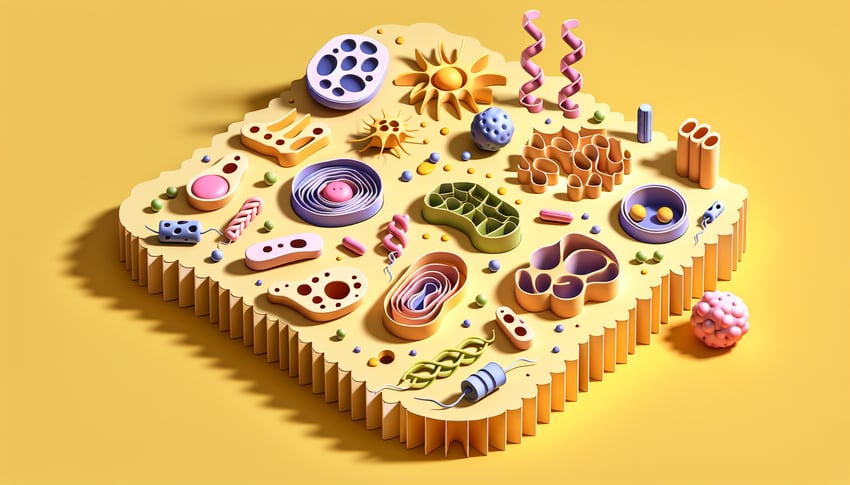
Organelle Function Quiz: Test Cell Parts and Their Jobs
This quiz targets cell biology at the level of introductory biology, AP Biology, and MCAT foundations: matching eukaryotic organelles to their core functions and to the pathways that connect them (protein secretion, recycling, and energy conversion). Expect to interpret organelle structure clues (membranes, stacks, enzymes) and choose the best function in context.
True / False
True / False
Select all that apply
Put in order
Frequent Organelle-Function Mix-ups (and How to Fix Them)
Most wrong answers in organelle-function quizzes come from mixing up where a process occurs with where its products end up. Use these high-frequency fixes to improve accuracy.
Confusing rough vs. smooth endoplasmic reticulum
- Common error: Saying smooth ER is the main site of protein synthesis.
- Fix: Protein synthesis (translation) happens on ribosomes; the rough ER is where ribosomes feed proteins into the ER for secretion/membranes/lysosomes. The smooth ER specializes in lipid synthesis, detoxification, and Ca2+ storage (especially in muscle).
Skipping steps in the secretory pathway
- Common error: Jumping from ribosome straight to Golgi or to the plasma membrane.
- Fix: Practice the default route: RER → transport vesicle → Golgi (cis to trans) → secretory vesicle → plasma membrane/exocytosis. If a question mentions signal peptide or membrane protein, think “RER entry.”
Mixing lysosomes, peroxisomes, and proteasomes
- Lysosome: acidic hydrolases digest macromolecules and worn organelles (autophagy) inside a membrane-bound compartment.
- Peroxisome: oxidation of fatty acids and detoxification of H2O2 via catalase.
- Proteasome: cytosolic/nuclear protein degradation of ubiquitin-tagged proteins (not membrane-bound).
Overusing “powerhouse” without mechanism
Fix: When mitochondria appear, tie function to structure: the inner membrane (cristae) hosts the electron transport chain and ATP synthase; the matrix hosts key steps of the citric acid cycle.
Forgetting plant-specific organelles and exceptions
Fix: Plants have chloroplasts and a large central vacuole; “lysosome” functions are often handled by lytic vacuoles in plants. If the prompt is explicitly about animal cells, don’t pick chloroplasts.
Organelle Function Essentials for Fast, Accurate Answer Choices
Use these five takeaways as a decision checklist when two options look plausible.
-
Decide first: cytosolic protein vs. secreted/membrane/lysosomal protein.
If a protein is destined for secretion, insertion into a membrane, or residence in the endomembrane system, it is translated on ribosomes bound to rough ER (via a signal peptide) and enters the ER lumen/membrane early. If it stays in the cytosol, it is made on free ribosomes.
-
Membrane stacks imply processing and sorting, not synthesis.
When you see “flattened sacs/cisternae” or “cis/trans faces,” pick the Golgi apparatus: it modifies (e.g., glycosylation), sorts, and packages cargo into vesicles. Avoid choosing Golgi for “where proteins are made.”
-
Match the organelle to its chemical environment.
Lysosomes are acidic for hydrolases; mitochondrial intermembrane space supports a proton gradient; peroxisomes manage oxidative reactions and H2O2. Questions often hide the answer in pH, enzymes (catalase), or “proton gradient” language.
-
Use “double membrane + own DNA” as a high-yield clue.
If the prompt mentions double membrane, circular DNA, or ribosomes inside the organelle, strongly favor mitochondria (ATP via oxidative phosphorylation) or chloroplasts (photosynthesis). This narrows choices quickly in labeling-style items.
-
Separate breakdown pathways by what is being degraded and where.
Proteasomes handle short-lived/misfolded proteins tagged with ubiquitin (cytosol/nucleus). Lysosomes digest bulk material, endocytosed cargo, and entire organelles (autophagy). If the question mentions “organelle recycling” or “autophagosome,” the answer is lysosome.
Authoritative References on Cell Organelles and Their Functions
- OpenStax Biology 2e: Eukaryotic Cells — Clear, course-aligned explanations of major organelles with function-focused summaries and diagrams.
- OpenStax Biology: The Endomembrane System and Proteins — A step-by-step treatment of ER-to-Golgi trafficking and secretion pathways.
- NCBI Bookshelf: Cytoplasm—Organelles and Functions — NIH-hosted text explaining organelle compartmentalization and the rationale for membrane-bound processes.
- NIH (NIGMS): Take a Tour of Your Cells’ Organelles — Visual, organelle-by-organelle overview that connects structure to biological role.
- HHMI Beautiful Biology: Cell Organelles — High-quality visuals with concise descriptions that reinforce identification-by-structure.
Organelle Function Quiz FAQ: Pathways, Exceptions, and High-Yield Distinctions
What is the most reliable way to distinguish rough ER from smooth ER in function questions?
Rough ER is defined by ribosomes on its cytosolic surface and is tied to proteins that enter the endomembrane system (secreted proteins, membrane proteins, many lysosomal enzymes). Smooth ER lacks ribosomes and is linked to lipid synthesis, detoxification (notably in liver cells), and Ca2+ storage (sarcoplasmic reticulum in muscle). If the prompt says “translation,” pick ribosomes, not smooth ER.
What sequence should I use for a typical secreted protein (the classic secretory pathway)?
Default pathway: ribosome on rough ER → ER lumen (folding/initial modifications) → transport vesicle → Golgi (cis to trans maturation and sorting) → secretory vesicle → plasma membrane → exocytosis. If a question mentions “sorting,” “packaging,” or “cis/trans faces,” it is pointing you to the Golgi.
Do plant cells have lysosomes, or is that an animal-cell-only organelle?
Many intro courses teach lysosomes as characteristic of animal cells. In plants, similar digestive and recycling roles are typically carried out by vacuoles (often called lytic vacuoles) that contain hydrolytic enzymes. On quizzes, read the stem carefully: if it explicitly says “plant cell,” a central vacuole may be the best match for storage and degradation functions.
How are lysosomes different from peroxisomes when both are “breakdown” organelles?
Lysosomes digest macromolecules using acidic hydrolases in a low-pH compartment and are central to endocytosis and autophagy. Peroxisomes specialize in oxidation reactions (including fatty-acid breakdown) and detoxify hydrogen peroxide using catalase. If the question mentions H2O2 or catalase, the answer is peroxisome.
Why do mitochondria and chloroplasts come up in organelle-function questions beyond “ATP” and “photosynthesis”?
They’re high-yield because their structure encodes their function: double membranes support specialized internal compartments; internal membranes (cristae in mitochondria, thylakoids in chloroplasts) maximize surface area for electron transport and chemiosmosis. They also connect to endosymbiotic theory via having their own DNA and ribosomes. If you want practice connecting cellular structures to system-level regulation, the Homeostasis Quiz pairs well with organelle questions on energy balance and detox pathways.